
Ever grabbed three different pairs of "size 34" pants off the rack, only to find they all fit completely differently? You're not going crazy. That number on the tag has become a wildly unreliable guide, turning what should be a simple shopping trip into a frustrating guessing game.
This is exactly why learning how to measure your waist size for pants isn’t just a handy trick anymore. It's a crucial skill for anyone who wants to buy clothes that actually fit the first time.
Why Your Pant Size Is Always a Guessing Game
Here’s the hard truth: there’s no universal standard for clothing sizes anymore. What one brand confidently calls a "Medium," another might slap a "Large" tag on. This sizing chaos didn't happen by accident—it’s the direct result of the fashion industry systematically moving away from regulated measurements.
It wasn't always like this. Decades ago, sizing guidelines were far more consistent. Then came the era of "vanity sizing," and everything changed. Brands figured out they could flatter customers by labeling clothes with smaller sizes than their actual measurements. It's a clever marketing tactic, for sure, but it leaves us all in the fitting room feeling completely confused.
The End of Sizing Standards
The problem really took off after 1983, when the U.S. government officially ditched its commercial sizing standards. To give you some perspective, a size 8 from 1958 was designed for a waist of about 23.5 inches. After the standards were dropped, brands were left to their own devices, creating the wild inconsistencies we’re stuck with today. If you're curious about the backstory, you can dive deeper into the history of sizing standards and their impact on ready-to-wear fashion.
Knowing this history is key because it explains why you simply can't trust the number on a label. Your perfect fit has nothing to do with a generic size and everything to do with your body's actual dimensions.
By taking your own measurements, you’re stepping outside the confusing world of vanity sizing. You empower yourself to choose pants based on reality, not a brand's marketing strategy.
Once you understand this industry-wide mess, you can stop playing the sizing lottery. Your measuring tape is your new best friend—the most reliable tool you have. Armed with your real measurements, you can confidently decode any brand’s size chart and finally find pants that feel like they were made just for you.
Getting the Right Tools for the Job
Forget about any fancy, complicated gadgets. You don't need a professional tailor's kit to get this right. Honestly, you probably have everything you need lying around the house already.
The one thing you absolutely must have is a soft, flexible measuring tape. I can't stress this enough. That rigid metal tape measure from your toolbox is great for furniture, but it's going to give you a completely wrong number for your body. You need something that can comfortably wrap around your waist.
Your Measurement Toolkit
Once you've got your tape, a couple of other things can make this whole process a lot easier and more accurate.
- A full-length mirror: This is your best friend for a quick visual check. It helps you see if you're standing up straight and, most importantly, if the measuring tape is level all the way around your back. It’s easy for it to dip or rise without you noticing.
- Something to jot it down: Whether it's a pen and paper or the notes app on your phone, write down the number the second you have it. Trust me, it's easy to forget or mix it up by the time you're looking at a size chart.
Prepping these simple items beforehand is the secret to getting a measurement you can actually rely on. It takes all the guesswork out of the equation.
And that's really all it takes! With these basics, you're ready to get a perfect measurement.
Finding Your True Waist Measurement
Alright, you've got your tools ready, so let's get down to business and find that magic number. Forget any overly complicated instructions you’ve seen before. Measuring your waist for a great pair of pants is actually pretty simple when you know what you're doing. This isn't about getting the smallest number possible; it’s about getting an honest measurement that will lead you to clothes that actually feel good to wear.
First things first, you need to find your natural waistline. This is the secret spot. It’s the narrowest part of your torso, usually sitting just an inch or so above your belly button.
Having trouble pinpointing it? Try this trick I always recommend: stand up straight and bend to one side like you're a little teapot. See that crease that forms? That's it. That's your natural waist, and that's exactly where you want to measure.
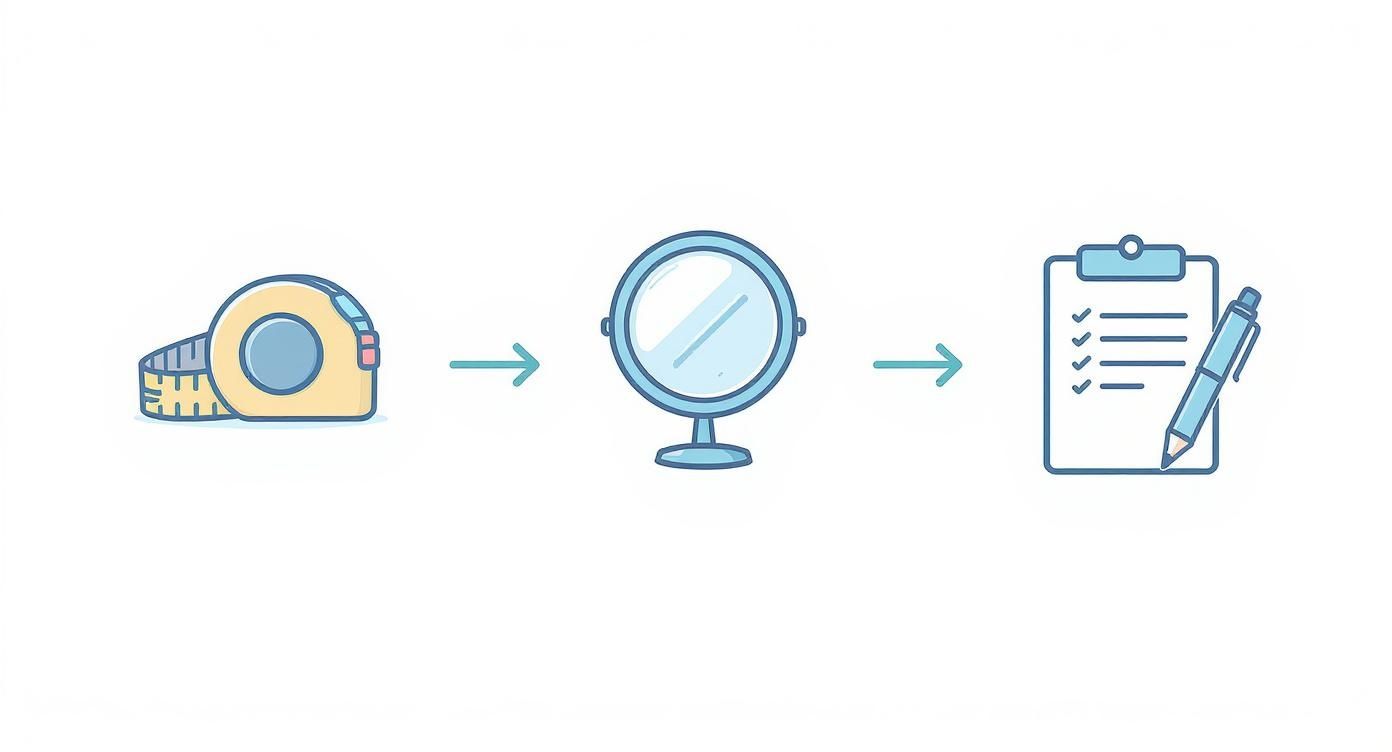
As you can see, the process is straightforward—all you really need is a flexible tape, a mirror to keep you honest, and a place to jot down your number.
Getting the Measurement Right
Now that you’ve located your waist, grab that soft measuring tape and wrap it around yourself. Take a quick look in the mirror to make sure the tape is parallel to the floor all the way around—it's easy for it to dip down in the back.
The tape should be snug, but not tight. You aren't trying to cinch yourself in. A great rule of thumb is you should just be able to slip one finger between the tape and your skin.
Okay, now breathe out normally. Relax your stomach muscles. No sucking in! This is a judgment-free zone. The number where the end of the tape meets the rest is your true waist measurement. Write that number down right away so you don't forget.
This whole quest for a reliable number isn’t new. The push to standardize clothing sizes actually kicked off in the late 1930s, when the U.S. government studied thousands of body measurements to create more consistent sizing. It's a fascinating look into the history of garment sizing and why it can still be so tricky today.
Remember, the goal is accuracy, not aspiration. A correct measurement is your single most powerful tool for finding pants that fit perfectly from the moment you put them on.
By taking a few moments to do this right, you’ll have a reliable number you can shop with confidently. This is the key to finally making online shopping less of a guessing game and more of a success story. Get it right, and you're well on your way to a wardrobe that truly works for you.
Common Mistakes That Lead to Poorly Fitting Pants
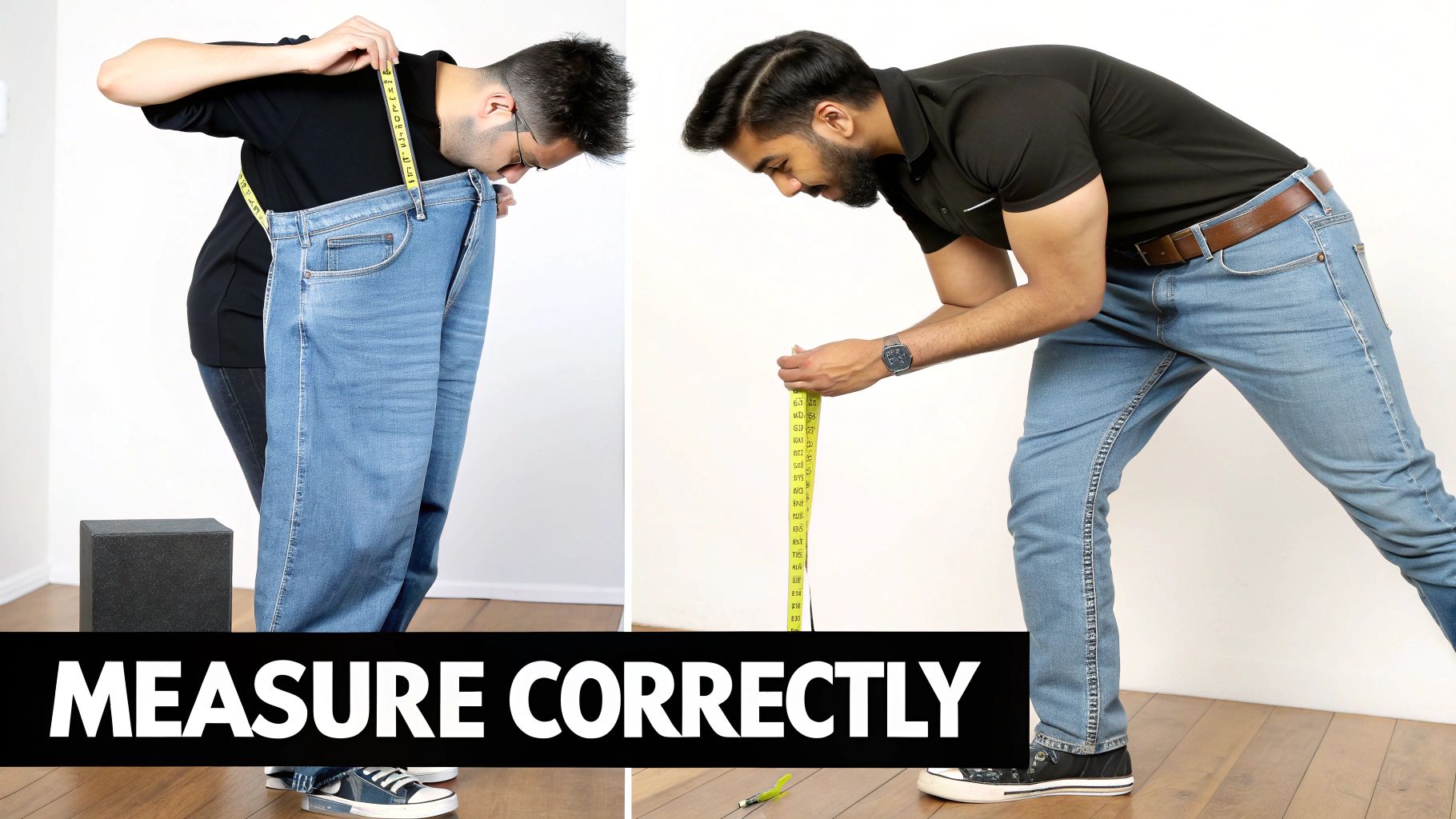
Knowing how to find your waist measurement is only half the battle. The other half is avoiding the simple, easy-to-make mistakes that can throw your number off completely. Honestly, even a half-inch mistake can be the difference between pants that feel custom-made and a pair that’s just… off.
Let's walk through the most common slip-ups I see, so you can nail your measurement on the first try. The biggest one? Measuring over bulky clothing. Tossing a measuring tape over your favorite chunky sweater or thick denim is a surefire way to add inches to your actual size. For a truly accurate number, you want to measure against bare skin or, at most, a very thin undershirt.
Ensuring Your Technique is Spot-On
Beyond what you're wearing, the way you actually use the measuring tape is critical. It’s almost a reflex for some people to pull the tape super tight or suck in their stomach, hoping to see a smaller number. Don't do it!
- Don't pull too tightly. The tape should feel snug, not constricting. It shouldn't be digging into your skin at all. A good rule of thumb is that you should be able to slip one finger comfortably between the tape and your body.
- Don't hold your breath. Just breathe out normally and let your abdomen relax. You're measuring for pants you'll wear while sitting, walking, and living your life—not just for the two seconds you can hold your breath.
- Keep the tape level. This one is sneaky. It's so easy for the tape to dip down in the back where you can't see it. Use a mirror to make sure the tape is perfectly parallel to the floor all the way around your torso. A sagging tape can easily shave off an inch.
An honest measurement is your best tool. The goal isn't to hit a specific number, but to find the measurement that leads to pants that fit you perfectly right now.
Think of it this way: each of these little details contributes to getting the right number, not just a number. When you avoid these common pitfalls, you’re setting yourself up for a perfect fit every single time you shop.
How to Use Your Measurement to Find the Right Size
So, you've got your number. Great! Now comes the moment of truth: translating that measurement into the right size on the product page. This little number is your secret weapon for cutting through the chaos of online sizing and finally getting a fit you can count on.
Every pair of pants on our site has its own specific size guide. Your job is to find it, pop it open, and match your measurement to the numbers you see.
https://www.youtube.com/embed/qqAWVuJvVn8
Let’s walk through it. Find the "waist" column in the chart and scan down until you find the range that your number falls into. For example, if you measured your waist at 33 inches, you'll likely see that corresponds to a Medium. It’s that simple. This direct comparison is the most reliable way to start when you're shopping for pants online.
Why You Can't Trust a "Standard" Size
Here’s a hard truth: a Medium from one brand is rarely the same as a Medium from another. The idea of consistent, universal sizing is a total myth.
Believe it or not, there used to be official standards. Back in 1958, the U.S. government actually published a sizing system where a size 8 was tied to a very specific 23.5-inch waist. But that system was officially ditched in 1983, leaving brands free to make up their own rules. This is the reason for all the madness and variation we see today. If you're curious about the nitty-gritty, TIME.com has a fascinating piece on the history of women's clothing sizes.
This history lesson really drives home one crucial point: you have to check the size chart for the exact item you’re buying, every single time. It's the only way to make a decision based on real data instead of just crossing your fingers and hoping for the best.
Your measurement is the constant; the size chart is the variable. Always trust your number and use the brand's guide to translate it correctly. This simple habit will save you from countless returns and fitting room frustrations.
Don't forget to think about the pant's rise, either. This is a huge factor. A high-rise pant is designed to sit at your natural waist, exactly where you measured. But for a mid-rise or low-rise style, the waistband is going to hit lower on your torso. Keeping the rise in mind helps you understand where the pant is supposed to fit, ensuring your measurement lines up with the intended style.
General Pant Size Conversion Chart
To give you a general idea of where your measurement might land, you can use this conversion chart as a starting point. It's a helpful reference, but remember, the brand's specific chart is always the final authority.
| Letter Size | Waist Measurement (Inches) | Waist Measurement (CM) |
|---|---|---|
| XS | 25" - 26" | 63.5 - 66 cm |
| S | 27" - 28" | 68.5 - 71 cm |
| M | 29" - 31" | 73.5 - 78.5 cm |
| L | 32" - 34" | 81 - 86.5 cm |
| XL | 35" - 37" | 89 - 94 cm |
| XXL | 38" - 40" | 96.5 - 101.5 cm |
Think of this table as your ballpark estimate. Once you find your potential size here, head over to the product's specific size guide to confirm the fit and make your final choice with confidence.
Answering Your Top Pant Fitting Questions
Even with a perfect measurement, buying pants online can feel like a gamble. You've got the number, but what about the style? High-rise, low-rise, stretchy, rigid—it all matters. Let's tackle those nagging questions that pop up right before you hit "Add to Cart."
Adjusting for Different Pant Styles
So, do you measure differently for high-rise jeans versus low-rise chinos? Yep, you absolutely should. Your natural waist measurement—that spot right above your belly button—is the gold standard for high-rise pants, since that's exactly where they're designed to sit.
But for mid-rise or low-rise styles, the game changes. The waistband on those will hit you lower down, somewhere between your navel and your hips. For the best fit, you'll want to measure that specific spot. Honestly, it's a smart move to have both your natural waist and your "low-rise" measurement written down.
When to Size Up or Down
It happens to everyone: you're stuck between a Medium and a Large. The tie-breaker here is almost always the fabric.
- Got stretchy fabric? Think of your favorite joggers or pants with a bit of spandex. You can usually get away with sizing down for a sharper, more fitted look without feeling constricted.
- Dealing with rigid fabric? This is your classic 100% cotton denim or linen. Always—and I mean always—play it safe and size up. There’s nothing worse than pants that pinch and pull every time you move.
My golden rule: When in doubt with non-stretch fabrics, size up. A tailor can work miracles taking in a waistband, but they can't magically create more fabric.
Keeping Your Measurements Current
Listen, our bodies change. It's just a fact of life. That measurement you took last year might not be your reality today.
I recommend making a habit of re-measuring yourself every 6 to 12 months. At the very least, do a quick check-in before you're planning a big wardrobe update. A few minutes with a tape measure can save you the headache of a return and ensure you're buying for the body you have right now.
Ready to see how an adjustable fit can make all the difference? The ModaMuse Men's Wide-Leg Striped Pants come with a drawstring waist, giving you that perfect custom feel every time. Find your perfect pair and experience true comfort today.
Article created using Outrank
